
September 24, 2026·3 min read
Papercut
When you cut a sheet of paper with scissors, the edge is never mathematically straight. Even when you guide the blade with precision, the paper gives way in tiny fractures. It yields to the grain, to the tension of your fingers, to the resistance of the fiber.
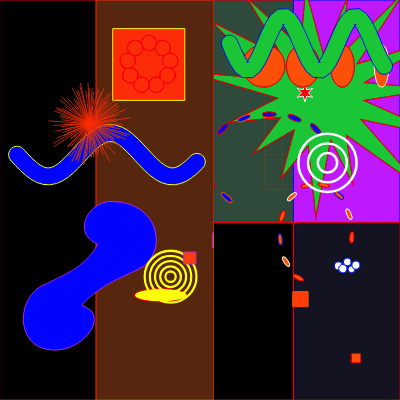
Papercut was born from the desire to translate that physical gesture into code. Not by simulating paper texture with filters or drop shadows, but by understanding the logic of collage: bold silhouettes, overlapping planes, vibrant chromatic clashes, and shapes that feel sliced from colored sheets and dropped onto an artboard.

The Logic of the Cut
In traditional collage, composition is an act of subtraction and placement. You cut a shape out of its original context, isolate it, and test where it belongs against a background.
In Papercut, the algorithm performs this same choreography in real time. Rather than relying on rigid geometric primitives, the generator operates with an organic vocabulary: ribbons that ripple like strips of cut paper, coiled worms, spiky starburst explosions, columns of ellipses, and drifting confetti particles.
Each piece is assembled on the fly in the browser. When the token renders, it is not fetching a flattened static raster; it is executing code that carves out shapes, calculates intersections, and lays down layers of color.
Panels and Compartments
One of the central mechanics of the collection is how space is divided.
In some iterations, the canvas remains a single undivided field (single), allowing a monumental hero form to dominate the space like a solitary sculpture. In others, the composition fractures into two, three, or four vertical compartments (panels-2, panels-3, panels-4).
These panels act like separate sheets of paper pinned side by side. Forms cross the boundary between panels, shifting their relationships as they traverse contrasting backgrounds. A ribbon or worm that begins in a dark field might slide into a lime or magenta panel, creating an unexpected rhythm that guides the eye across the frame.
Chromatic Voltage
Color in Papercut is deliberately high-contrast and assertive.
Inspired by screenprinting posters and modern graphic design, the palettes pair unexpected neighbors: electric pink against deep olive green, bright cadmium orange over stark black, sky blue meeting radiant lime, coral next to violet.
The color is never incidental. Each seed chooses a background mood—from Sky Lime and Pink Candy to Salmon Split and Mono Pop—and sets up a dominant hue that anchors the hero shapes. The result is a visual tension where colors push and pull against each other, giving flat vectors a sense of tactile weight.
800 Iterations
Like Drift, Papercut is hosted on bootloader.art on the Tezos blockchain.
The collection is capped at 800 editions. In a generative series, the edition size is part of the architecture. With 800 possible iterations, the combinatorial space of layouts, hero shapes, colorways, and particle densities has room to breathe. Some combinations will feel sparse, contemplative, almost minimal; others will explode with kinetic density and starburst energy.
Each edition is sealed forever by its seed at the moment of minting. The algorithm remains constant, but the seed unlocks a unique moment within the system—a cut that has never been made before, and will never be made again.
The collection is available to explore and mint directly on bootloader.art and through the portfolio.